Photo Album

Showing posts with label Fossil. Show all posts

Saturday, November 26, 2011

Sunday Round Up


Sunday Round Up is a post where I highlight all the great articles I read this week, but didn't have time to post about. Most of these articles are Archaeology News from around the world. History, Egyptology and other articles also included.

Some Articles I read:

* The Lost City of the Pyramids
* How Old are the Pyramids?
* Talking Trash Through the Ages
* Whales in the desert: Fossil bonanza poses mystery

Some Websites I found:

* California Academy of Skulls
* Underwater Archeology
* Ancient Egypt Research Associates
* Archaeography Photoblog
* Theban Mapping Project

Sunday, November 20, 2011

The Human Lineage Through Time

I stumbled upon an amazing website called Becoming Human, that has a wonderful interactive timeline of the human lineage through time.

Click here to see it, or on the picture/preview below:


Source: http://www.becominghuman.org/node/human-lineage-through-time

Wednesday, May 11, 2011

Ancient Toothache

The world's first known toothache has been found in an elderly reptile around 275 million years old.
"The question then arises, 'Did it die because of the infection?' We cannot tell. But it probably was a contributing factor," Reisz said. (Source)

"It looks like the animal broke its tooth and because it doesn't replace its tooth, that became a hole — and through that hole, oral bacteria probably entered the inside of the jaw and then gradually the jaw was closed up," Reisz told LiveScience. He added that it was likely a pretty bad infection. "The infection raveled about four or five teeth into the area where the jaw is quite thin, and that's where it went into the mouth area and the outside of the jaw," Reisz said. "As a consequence, that area of the jaw is really damaged." (Source)
The study is detailed online in the journal Naturwissenschaften - The Science of Nature.

For more information and pictures:
http://www.livescience.com/13759-oldest-toothache-reptile-fossils.html

Tuesday, March 22, 2011

Giant Rabbit fossil found!

Just for interest sake :)
Source: Commons - http://www.curiosidadeanimal.com/anatomia_coelho.shtml

In Spain researchers have unearthed the fossil skeleton of a giant rabbit. It was found on the island of Minorca. It is said to have weighed 26.4 pounds and is between 3-5 million years old.

It was so big that it most likely lost its ability to hop.

Read more: http://www.upi.com/Science_News/2011/03/21/Spanish-island-yields-giant-rabbit-fossil/UPI-71941300752493/#ixzz1HJKrAnau
and here: http://www.cbsnews.com/stories/2011/03/21/scitech/main20045568.shtml 

Tuesday, February 15, 2011

Fossilized foot bone tells its secrets

3.2 Million-Year-Old Fossil Foot Bone Supports Human-Like Bipedalism In Lucy's Species
 Commons: http://commons.wikimedia.org/wiki/File:Gray268.png
"A fossilized foot bone recovered from Hadar, Ethiopia, shows that by 3.2 million years ago human ancestors walked bipedally with a modern human-like foot, a report that appears Feb. 11 in the journal Science, concludes. The fossil, a fourth metatarsal, or midfoot bone, indicates that a permanently arched foot was present in the species Australopithecus afarensis, according to the report authors, Carol Ward of the University of Missouri, together with William Kimbel and Donald Johanson, of Arizona State University's Institute of Human Origins."
For the full article and source:
http://www.medicalnewstoday.com/articles/216259.php

Thursday, February 10, 2011

Rare Insect Fossil

Rare Insect Fossil Reveals 100 Million Years of Evolutionary Stasis

Just for effect
Source: http://commons.wikimedia.org/wiki/File:Fossilcricket.jpg
"ScienceDaily (Feb. 4, 2011) — Researchers have discovered the 100 million-year-old ancestor of a group of large, carnivorous, cricket-like insects that still live today in southern Asia, northern Indochina and Africa. The new find, in a limestone fossil bed in northeastern Brazil, corrects the mistaken classification of another fossil of this type and reveals that the genus has undergone very little evolutionary change since the Early Cretaceous Period, a time of dinosaurs just before the breakup of the supercontinent Gondwana."

Read more:
http://www.sciencedaily.com/releases/2011/02/110203113758.htm

Tuesday, February 8, 2011

Ancient Rabbit Skull

Fossilized ancient rabbit skull on display in Beijing

Source: http://commons.wikimedia.org/wiki/File:Darwin_Variation_Fig6-7.jpg

In Beijing a skull of an ancient rabbit is on display at the Paleozoological Museum of China. It is estimated to be around 54 million years old.

The Skull is so small it has to be looked at through a magnifying glass.

The Dawsonlagus antiquus rabbit was found in 2007 and is believed to be the oldest remain of the species.

Source:
http://in.news.yahoo.com/fossilized-ancient-rabbit-skull-display-beijing-20110206-125305-757.html
and http://en.ce.cn/National/culture/201102/06/t20110206_22194638.shtml

Thursday, November 25, 2010

3000 year old seeds / Ice Age ecosystem

3000 year old seeds found  

Archaeologists found many well-preserved fruit and vegetable seeds, including almonds and melon seeds, from more than 3,000 years ago — some even look like new seeds — according to the Shaanxi Provincial Institute of Archaeology on Nov. 20. (Source)
It is suggested that people from the Zhou Dynasty had storage units that were capable of keeping things fresh. 500 almonds, 10 prunus seeds, 150 Cucurbitaceae seeds, 108 unbroken and 839 half broken seeds have been found.
"The inner walls under the covers were evenly smeared with cob of two to three centimeters, and then were dried. With the four angles as the boundary line, there are two layers of soil in the pit, with the upper layer being light brown soil and the lower layer being yellow-gray soil. The upper layer soil is loose and contains a few processed stone drills, animal bones and potteries. The lower layer soil is compact but has obviously less amount of soil and a large number of plant seeds can be seen with naked eyes." (Source)

Source: http://english.peopledaily.com.cn/90001/90782/7207914.html

 Ice Age ecosystem found near Snowmass

DENVER — Back at the Denver Museum of Nature & Science, crews that spent a month of frenzied fossil discovery at a 130,000-year-old muddy lake bed near Snowmass Village are finding their Ice Age treasure even more magnificent than previously revealed. (Source)

Museum workers — 67 individuals — recovered more than 500 bones representing eight to 10 American mastodons, four Columbian mammoths, four Ice Age bison, two deer, Colorado's first-ever Jefferson's ground sloth, several smaller animal species and hundreds of pounds of plant material. (Source)
Look at these amazing pictures: http://www.snowmasssun.com/article/20101118/FRONTPAGE/101119967/1001&parentprofile=1044
More on this: http://www.aspentimes.com/article/20101119/NEWS/101119827/1001

Wednesday, November 17, 2010

A Road lined with Sphinxes found / Ancient people more promiscuous?

Sphinx road found in Egypt


A sphinx-lined road (consisting of 12 sphinxes) has been found by Egyptian archaeologists in Luxor. It is said to have led to the temple of Mut.

Most of the sphinxes don't have their heads, and the name Nectabo 1 is inscribed on them. Most of them date back to 362 BC.

"This discovery marks the first time that archaeology has revealed this route, which is mentioned in many ancient texts," the statement said.

Read more: http://www.thirdage.com/news/sphinx-statues-discovered-egypt_11-15-2010#ixzz15QLdCpPc
http://www.thirdage.com/news/sphinx-statues-discovered-egypt_11-15-2010
http://www.qt.com.au/story/2010/11/16/12-more-sphinx-statues-unearthed-in-egypt/ 

Were Neanderthals More Promiscuous Than Modern Humans?


A study at the universities of Liverpool and Oxford using fossil finger bones suggest that Neanderthals were more promiscuous than humans today.
The team found that the fossil finger ratios of Neanderthals, and early members of the human species, were lower than most living humans, which suggests that they had been exposed to high levels of prenatal androgens. This indicates that early humans were likely to be more competitive and promiscuous than people today. (Source)
To find out more you will have to read the article, as it gets a bit technical!

Source:
http://www.sciencedaily.com/releases/2010/11/101103081915.ht

Sunday, November 14, 2010

Complete Mammoth Skeleton / Origins of First European Farmers

Complete Mammoth Skeleton found


It looks like a discovery in Lea County, N.M., could be a complete mammoth skeleton. The mammoth was found Delbert Sanderson, who saw the femur bone fossil sticking up out of the ground.

The New Mexico Natural History Museum Executive Director Calvin Smith said: “It is a major discovery,” “We usually find pieces and parts, but if this is a complete skeleton, it is very important.” “It is a significant find and one that deserves a lot of attention,” “If we are on the bottom of it, we are through, if we are on the top of it, we have another year’s work.” (Source)

So far  a femur, tibia, fibula and a carpal has been found

More on this:
http://www.durangoherald.com/article/20101114/NEWS02/711149927/0/s/Lea-County-fossil-find-may-be-whole-mammoth
http://www.koinlocal6.com/news/national/story/New-Mexico-fossil-find-could-be-complete-mammoth/H1YSK2w7X02bLtfCrygwgw.cspx

DNA Reveals Origins of First European Farmers


A team of international researchers led by ancient DNA experts from the University of Adelaide has resolved the longstanding issue of the origins of the people who introduced farming to Europe some 8000 years ago. (Source)

A detailed genetic study of one of the first farming communities in Europe, from central Germany, reveals marked similarities with populations living in the Ancient Near East (modern-day Turkey, Iraq and other countries) rather than those from Europe. (Source)

Project leader Professor Alan Cooper, Director of the Australian Centre for Ancient DNA (ACAD) at the University of Adelaide, says: "This overturns current thinking, which accepts that the first European farming populations were constructed largely from existing populations of hunter-gatherers, who had either rapidly learned to farm or interbred with the invaders." (Source)

The results of the study have been published today in the online peer-reviewed science journal PLoS Biology. (Source)

"We have finally resolved the question of who the first farmers in Europe were -- invaders with revolutionary new ideas, rather than populations of Stone Age hunter-gatherers who already existed in the area," says lead author Dr Wolfgang Haak, Senior Research Associate with ACAD at the University of Adelaide. (Source)

"We've been able to apply new, high-precision ancient DNA methods to create a detailed genetic picture of this ancient farming population, and reveal that it was radically different to the nomadic populations already present in Europe. (Source)

"We have also been able to use genetic signatures to identify a potential route from the Near East and Anatolia, where farming evolved around 11,000 years ago, via south-eastern Europe and the Carpathian Basin (today's Hungary) into Central Europe," Dr Haak says. (Source)
Source:
http://www.sciencedaily.com/releases/2010/11/101109172344.htm

Sunday, November 7, 2010

Bison Skull found / Pompeii could collapse

Ice Age bison skull found


A 250 pound bison skull has been found by a construction crew outside Snowmass Village. The skull is twice the size of a modern bison with the span of the horns more than 6 feet.


Other specimens have been found at the same dig site and include a Columbian mammoth, American mastodon and an Ice Age deer.

More articles:
http://www.washingtonexaminer.com/local/ap/enormous-ice-age-bison-skull-found-106861243.html
http://www.thedenverchannel.com/news/25666299/detail.html

Pompeii could collapse


Italy's culture minister said that more buildings inside Pompeii could collapse. This comes after a 2 000 year old house disintegrated.

So many buildings need restoration that damage is inevitable said Daniela Leone, a spokeswoman for Pompeii's archaeological superintendence.
 
More on this:
http://www.boston.com/news/science/articles/2010/11/07/italy_more_building_collapses_at_pompeii_possible/
http://www.straitstimes.com/BreakingNews/World/Story/STIStory_600588.html
http://www.odt.co.nz/news/world/135264/italy-warns-more-building-collapses-pompeii
http://www.stuff.co.nz/world/europe/4319286/More-Pompeii-treasures-at-risk


Tuesday, October 26, 2010

Big Amber Find / Vampires / Ancient Roman Shipwreck

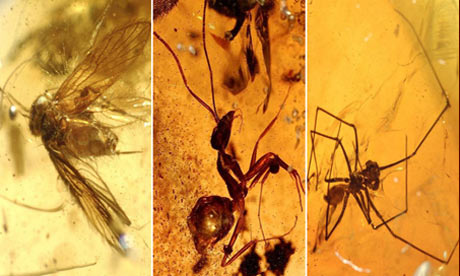
Prehistoric creatures discovered in huge Indian amber haul

Fossil hunters find 150kg of amber in Gujarat province containing over 700 arthropod specimens

Amber combo
 
Photographs: University of Bonn/David Grimaldi/AMNH
 
Hundreds of creatures have been found in amber (150kg) excavated in western India. These creatures include ancient bees, spiders, termites and ants etc. More than 700 arthropods have been identified.
"They are so well preserved. It's like having the complete dinosaur, not just the bones. You can see all the surface details on their bodies and wings. It's fantastic," Rust told the Guardian. The remains of two praying mantises were also found.

Michael Engel, curator of entomology at the University of Kansas, said: "What we found indicates that India was not completely isolated, even though the Cambray deposit dates from a time that precedes the slamming of India into Asia. There might have been some linkages."
Sources:
http://www.guardian.co.uk/science/2010/oct/25/prehistoric-creatures-indian-amber-haul
http://news.yahoo.com/s/afp/20101025/sc_afp/usindiapaleontolgyasia_20101025230555;_ylc=X3oDMTEwODNhcGlyBF9TAzIwMjM4Mjc1MjQEZW1haWxJZAMxMjg4MDUwNjc4
http://www.bbc.co.uk/news/science-environment-11618809

Demystifying the history of vampires

The Penn Museum hosted a discussion on monsters in the Ancient World.
See article here: http://thedp.com/article/demystifying-history-vampires


Ancient Roman shipwreck


Just for illustration
 
A sunken warship has recently been found in the Mediterranean Sea. It might point to a major ancient battle in which Rome trounced Carthage.

Source: http://www.msnbc.msn.com/id/39727737/ns/technology_and_science-science/

Monday, October 25, 2010

CT scanning a Fossil / Tombs Discovered in Egypt

CT scan to determine outback fossil find


An Ancient fossil embedded in a rock has been found near Winton, north-west of Longreach. It is estimated at about 98 million years old.
Spokesman David Elliot says it is still determining if it could be a pterosaur, which is a flying reptile, or another animal. Mr Elliot says the bones were put through a CAT scan at Mackay's Mater Hospital and will now be digitally pieced together.

"It entails a very specific ... computer software to convert the CT scan back into digital images and then transform those images then into what the bones [are] supposed to be," he said. (Source)
Source: http://www.abc.net.au/news/stories/2010/10/25/3047543.htm

Discovery of 4 300 year old tombs in Egypt

A new double tomb has been discovered in Saqqara near Cairo, it is also said to have had vivid wall paintings. The tomb also has two false doors.
Egypt's antiquities chief, Zahi Hawass, said the new finds were "the most distinguished tombs ever found from the Old Kingdom," because of their "amazing colors." He said the area, if excavated, could unveil the largest cemetery of ancient Egypt. (Source)
The paintings on the false doors identified Shendwas and Khonsu as royal scribes and "supervisors of the mission," meaning they were in charge of delegations overseeing the supply of materials used for pyramids construction. (Source)
Source: http://www.boston.com/news/science/articles/2010/07/08/egypt_unveils_discovery_of_4300_year_old_tombs/


Monday, October 18, 2010

Fossil Spider

Jurassic Spider

Image: Paul Selden
Source:  http://www.wired.com/wiredscience/2010/10/best-fossils/

This find was showcased in this year’s best finds of National Fossil Day. The Spider was found in China and dates to the middle Jurassic era and was preserved in fine volcanic ash. 

Personally it gives me the creeps :)
http://www.wired.com/wiredscience/2010/10/best-fossils/

Monday, October 11, 2010

Dinosaurs Not So Fierce After All / Small Fossil footprints / Giant penguin fossil

New Fossil Suggests Dinosaurs Not So Fierce After All


Sarahsaurus is a genus of basal sauropodomorph dinosaur as depicted above

ScienceDaily (Oct. 5, 2010) — A new species of dinosaur discovered in Arizona suggests dinosaurs did not spread throughout the world by overpowering other species, but by taking advantage of a natural catastrophe that wiped out their competitors. (Source)
The above mentioned dinosaur species is called Sarahsaurus. Sarahsaurus was 14 feet long and lived 190 million years ago.

By looking at the Sarahsaurus species scientist maintain that:
Dinosaurs did not spread throughout the world by overpowering other species, but by taking advantage of a natural catastrophe that wiped out their competitors. (Source)
"We used to think of dinosaurs as fierce creatures that outcompeted everyone else," said Rowe. "Now we're starting to see that's not really the case. They were humbler, more opportunistic creatures. They didn't invade the neighborhood. They waited for the residents to leave and when no one was watching, they moved in." (Source)
Source:
http://www.sciencedaily.com/releases/2010/10/101006085240.htm
http://www.eurekalert.org/pub_releases/2010-10/uota-nfs100110.php


Fossil footprints point to dainty dinos


Just for illustration - Source - Author: Jeff Kubina

In Poland tiny footprints of dinosaurs (Prorotodactylus mirus) have been found. They are believed to be the forerunners of triceratops and brontosaurus and they were four-footed. The tracks are around 249 to 251 million years old and are only two to four centimeters across and They were four-footed.

Source: http://news.theage.com.au/breaking-news-world/fossil-footprints-point-to-dainty-dinos-20101006-166wb.html


Giant penguin fossil gives evolutionary clues


Illustrations of penguin bones produced for James Hector's 1872 article on fossil penguins.
LIMA (Reuters) - The preserved feathers and scales of a giant fossilized penguin discovered on Peru's central coast provide a glimpse of Peru's Eocene period, and how the species evolved to its modern state, paleontologists say. (Source)
The ancient penguin was around 1.5 meters  and is date to 36 million years ago. The penguin was named "Inkayacu paracasensis," which means "emperor of the water" in Quechua.
"Without doubt this is the most complete specimen of ancient penguins that exists," said Rodolfo Salas-Gismondi, the lead paleontologist and the head of the University of San Marcos' Museum of Natural History in Lima. (Source)
The findings were first revealed in the September 30 issue of Science.


Source: http://au.news.yahoo.com/a/-/technology/8077915/corrected-giant-penguin-fossil-gives-evolutionary-clues/

Tuesday, October 5, 2010

Fossil discovered / Pirates booty / Aryan city found

 7 year old finds dinosaur jaw bone


A 7 year old boy found a dinosaur jaw fossil from a juvenile meat-eating dinosaur at a dinosaur park. The fossil dates to around 116 million years ago. It is also significant because it is the first jawbone to be found in Maryland from a meat-eating dinosaur.
  
More on the subject:
http://times-news.com/local/x1618820098/7-year-old-finds-fossil-at-dinosaur-park
http://www.nbcwashington.com/news/local-beat/Theres-Dino-Gold-in-Them-Thar-Hills-104309514.html

Artifacts to be recovered from Blackbeard's flagship

The Capture of the Pirate Blackbeard by Jean Leon Gerome Ferris, 1718

Archaeologists are continuing an effort recover artifacts from the wreck believed to be Blackbeard's flagship. The flagship is called Queen Anne's Revenge and was believed to have sunk in 1718 near Beaufort, N.C.

There are cannons, anchors and other artifacts that can be removed. This expedition marks the first serious excavation in two years on this ship.

More info:
http://www.foxnews.com/scitech/2010/10/04/archaeology-blackbeard-pirate-ship/

Aryan city discovered in Russia  


Russian archaeologists have found 20 spiral-shaped settlements that they believe was built by the original Aryan race about 4,000 years ago. They found this in southern Siberia bordering Kazakhstan.

These settlements could house up to 2000 people, and tons of artifacts, including pottery and make-up equipment has been found.
Evidence of ritual horse burials were found at the site which ties in with ancient Aryan texts that describe the animals being sliced up and buried with their masters.

Hughes, a visiting research fellow at King's College London, said that "ancient Indian texts and hymns describe sacrifices of horses and burials and the way the meat is cut off and the way the horse is buried with its master".

"If you match this with the way the skeletons and graves are being dug up in Russia, they are a millimetre-perfect match." (Source)
More info:
http://hindu.com/2010/10/05/stories/2010100557652000.htm


Read more at: http://www.ndtv.com/article/world/4000-year-old-aryan-city-discovered-in-russia-56951?trendingnow&cphttp://www.ndtv.com/article/world/4000-year-old-aryan-city-discovered-in-russia-56951?trendingnow

Thursday, September 30, 2010

100 Million Years Old Crocodile Skull Unearthed

 Crocodile Skull Unearthed

Source: Commons

This is old news, but nonetheless fascinating!
ScienceDaily (2009-07-16) -- Paleontologists have made the most important discovery to date at the Arlington Archosaur Site, a prolific fossil site in Texas. The disassembled skull of a crocodile with two-and-a-half-inch-long teeth that lived nearly 100 million years ago has been unearthed. (Source)
A story so close to my heart!

More here: Skull Of Crocodile 100 Million Years Old Unearthed

Tuesday, September 28, 2010

Ancient Plant "painting" discovered / Dinosaur head reconstructed

Ancient Plant "painting" discovered

A plant fossil that looks strangely like one of Vincent van Gogh's paintings has been found. Have a look at it HERE.

The plant is believed to be the ancestor of daisies and sunflowers and dates back to around 50 millions years. It was found in north-west Patagonia.

Source: http://uk.news.yahoo.com/21/20100923/tsc-fossil-of-ancient-plant-discovered-4b158bc.html

Dinosaur head reconstructed

 
Ichthyosaur
English: Photographer: User:Ballista from Dinosaurland, Lyme Regis, England 

A old skull belonging to a Ichthyosaur has been pieced together by Mike Harrison, 47. It took him 2 years.  

You can view the Picture HERE. It looks creepily like a crocodile. 

The reason it took 2 years is that Mike found 21 shards of bone after a landslide and it took him 6 months to get all the pieces.
The find has been registered with the Charmouth Heritage Centre and will then be sent to a museum.
Palaeontologist Phil Davidson said: ''It's fairly common to find small isolated bones on the beach, but to find such an enormous skull is very rare.

''The time and effort Mike put into finding it, going back again and back again after the landslide is incredible.''
Ichthyosaurs could breath air like whales and had speed (estimated 40km per hour). They appeared around 245 million years ago and disappeared about 90 million years ago.

Source: http://www.telegraph.co.uk/science/dinosaurs/8022622/Dinosaur-head-rebuilt-after-fossil-jigsaw-puzzle.html

Sunday, September 26, 2010

2 new dinosaur species discovered!

I'm a little late with this news, but here it is:

2 New horned Dinosaurs!

Image just for illustration purposes.

In Utah scientists have discovered two new dinosaur species. They are said to be closely related to the Triceratops.

One of the dinosaurs has 15 horns on its head and would have eaten plants, it was named Kosmoceratops richardsoni. The other one only has 5 horns. It is however larger than the first and was named Utahceratops gettyi 
"The horns really are probably developed at puberty, because most likely these are signals for mate recognition, competition between males, things like that," Loewen said. "They're sexual signals and really that's how we think this group of dinosaurs divided." (Source) 
The Skulls will be on display at the Utah Museum of Natural History for the rest of the year. (Source)

For more info:
http://news.yahoo.com/s/ap/20100923/ap_on_sc/us_dinosaur_discovery
http://news.yahoo.com/s/afp/20100923/sc_afp/sciencepaleontologydinosaurus_20100923154425
http://www.bloomberg.com/news/2010-09-22/dinosaurs-with-15-horns-7-foot-heads-are-discovered-in-utah.html

Thursday, September 23, 2010

Theater Box found / Fossil bed found in California

Theater box found at Herod's palace


A private box that is located in a 400-seat theater located at King Herod's winter palace in the Judean desert has been found.The room is very extravagant and elaborate paintings and plaster are on the walls.

Source: http://www.boston.com/news/world/middleeast/articles/2010/09/21/archaeologists_find_theater_box_at_herods_palace/

Fossil bed found in California
Source: Richard Wheeler (not anything to do with the discovery in California)

In California, on a substation building site, 1500 bone fragments (1.4 millions years old) have been found. Included in this find is sabre-toothed tiger remains and tons of other animal remains. Also tons of plant matter.
In fact, the number of skeletons found at the site could indicate that a marsh or a lake bed could have existed, trapping animals looking for water, leaving them vulnerable to predators. A paleontologist said that the find wasn't directly comparable to Le Brea, as it consisted of different species from another era. However, he did say it would definitely be valuable. (Source)
Source: http://www.newkerala.com/news2/fullnews-46559.html