Photo Album

Showing posts with label New Discoveries. Show all posts

Tuesday, June 14, 2011

Japanese porcelain found in Cebu excavation.


The Article:
"A Japanese archaeologist confirmed the existence of 17th- to 19th-century Japanese ceramics in Boljoon town, southern Cebu, the first intact artifacts found in the country.

Dr. Takenory Nogami, a Japanese researcher from the Arita Museum of History, expressed excitement over the discovery of a large dish and a jarlet “emariware” or Japanese porcelain.

“The recovered pieces in Boljoon are unique because it is still intact in the aquare,” Nogami told reporters in the Museo sa Sugbo last Saturday.

The pieces were discovered in 2009 through an excavation project of the Sumitomo Foundation-funded Boljoon Archaeological Project conducted by the University of San Carlos (USC) with the National Museum of the Philippines."
Source: Japanese porcelain found in Cebu excavation

Read more about it:
http://cebudailynews.wordpress.com/2011/05/30/ancient-japanese-pottery-in-boljoon-town/
http://newsinfo.inquirer.net/10434/ancient-japanese-pottery-in-boljoon-town

After reading this article I was curios to see what exactly Japanese porcelain looks like, and this is what I found:


I then discovered a brilliant site about Japanese Porcelain marks over here:
Click Here

I found some great information and pictures:
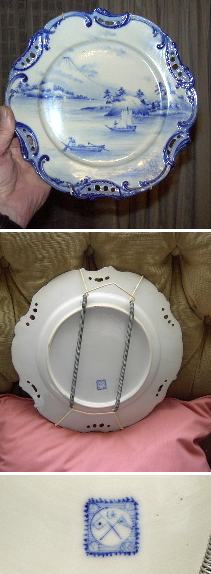


"Mark: Crossed Imperial Chinese and Japanese flags with the Turkish crescent moon and star in-betwen, refering to Mr AA Vantines business relations with these three countries. Tentative date: c. 1910-20's."
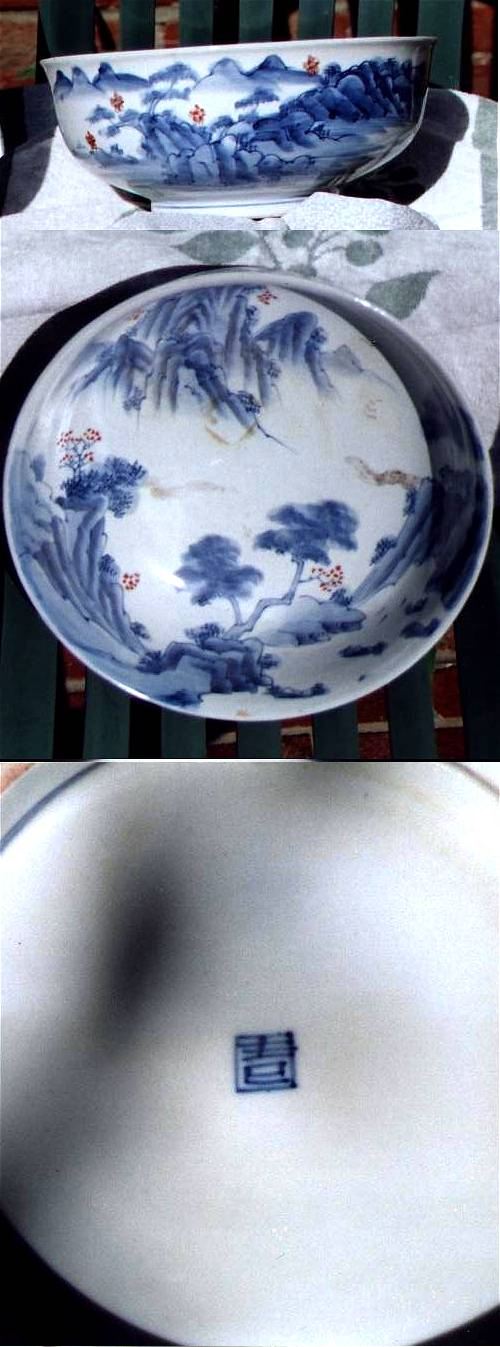


"Mark: Mark: Aoki, unknown meaning possible a family name. Porcelain made at Arita kiln. Bowl. Diameter 12", height 5"."
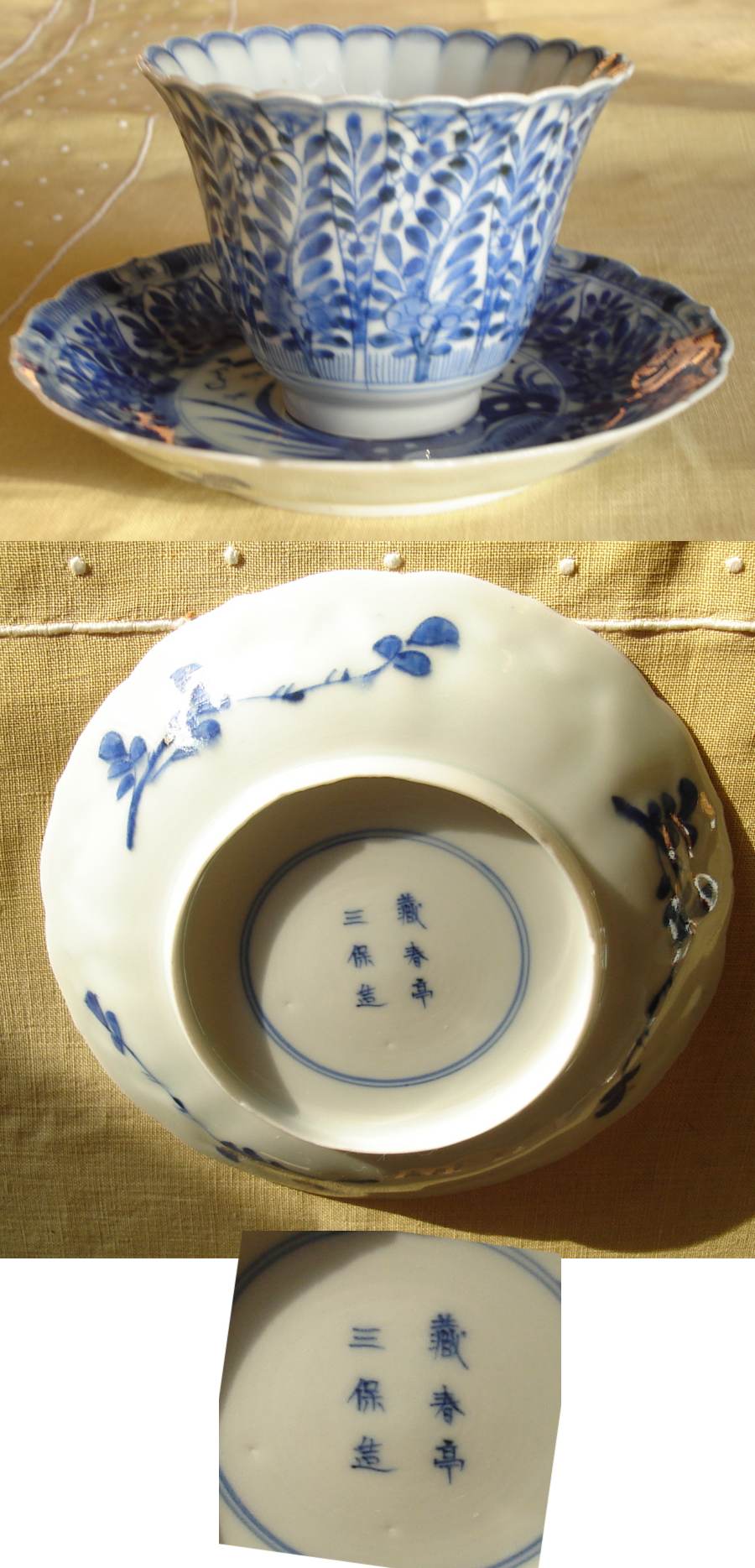


"Tea cup and dish with underglaze blue and white decoration in imitation of Chinese Kangxi period (1662-1722) porcelain. Mark: "Zoshuntei Sanpo Zu "Zoshun (shop) Sanpo Made (made by Sanpo). Good quality, mid 19th century, Japanese export ware. Mid 19th century."

I wouldn't mind a Tea Cup like that!

There are tons more on the website.

I can see myself looking for Japanese Porcelain Marks whenever I'm at a Flea Market!

Saturday, June 11, 2011

Spectacular Ancient Greek artefacts unveiled!


Medusa Gold, from the tomb of Philip II

In the Macedonian city of Aegea, archaeologist found tombs with hidden treasures. These tomb’s secrets lay untouched and concealed from the world till the 1970s when Professor Manolis Andronikos discovered them.

It then came to light that they were the tombs of members of Alexander the Great’s direct family. But what was also extraordinary was that the tomb of King Philip II was also amongst them.

Did you know?

* King Philip II was king from 359 BC until 336 BC when he was assassinated by Pausanias of Orestis, one of his bodyguards. But don’t fret he didn’t get off scot free. He was found by Phillip II’s other bodyguards and they killed him. 
* He was also the father of Alexander the Great and Philip III.

Now as you can see this is a very important archaeological site. That is why the Ashmolean Museum is exhibiting over 500 spectacular archaeological objects, some that have never been seen before.

Some items include: 

* A golden head of Medusa (By the way if anyone finds a picture of this, please share with me)
* Armor
* Golden wreaths

Truly remarkable finds, I wish I could go to the Museum and see these items for myself!


Sources:
Heracles to Alexander: Ashmolean Museum unveils spectacular collection of Ancient Greek artefacts
http://eu.greekreporter.com/2011/03/29/heracles-to-alexander-the-great-exhibition-at-oxfords-ashmolean-museum/
http://eu.greekreporter.com/2011/02/25/alexander-the-great-exhibition-hosted-at-asmolean-museum-oxford/
http://en.wikipedia.org/wiki/Philip_II_of_Macedon

Wednesday, June 8, 2011

The Archaeology News Network: Dig site gives glimpse into ancient daily life

On a routine dig in Beijing's north-western suburbs some rare discoveries were made. An ancient village that's over 2000 years old was found, as well as 21 ash pits and 24 houses.

For more on this:
The Archaeology News Network: Dig site gives glimpse into ancient daily life

Tuesday, May 31, 2011

Bones of elephant ancestors discovered in Oman

Geologists from the Sultan Qaboos University discovered the remains "of the oldest ancestors of elephant (Barhtyerium)".

Fossil discovered in Dhofar region in south of Oman [Credit: Gulf News]
For more information and source:
http://archaeologynewsnetwork.blogspot.com/2011/05/bones-of-elephant-ancestors-discovered.html

Thursday, May 26, 2011

Egyptian pyramids found by infra-red satellite images

Just for illustration purposes

Seventeen lost pyramids were found in a new satellite survey of Egypt. Also more than 1,000 tombs and 3,000 ancient settlements. Excavations have already shown this to be true.

This is a fascinating discovery and you can read more here: http://www.bbc.co.uk/news/world-13522957
Source: http://www.bbc.co.uk/news/world-13522957

Thursday, April 7, 2011

Ancient "Pickled" Brain?

Source: http://resumbrae.com/ub/dms423_f07/04/


In 2008, a brain was found still preserved in mud. It was not done deliberately tho, it was the wet clay that preserved it.

The human brain dates between 673 and 482 B.C and most likely belonged to a man between 26 and 45 who was hanged and decapitated.
Still, these theories don't fully explain why the brain "didn't turn into mush," Collins said.
(Read "Beyond the Brain" in National Geographic magazine.) (source)

"It's curious, because normally it is one of those organs that degrade quickly," he said. "There must be something going on internally that we don't understand." (source)
Source:
http://news.nationalgeographic.com/news/2011/04/110406-oldest-brain-britain-archaeology-science-world/

Pictures:
http://news.nationalgeographic.com/news/2011/04/pictures/110406-oldest-human-brain-britain-science/

Wednesday, March 30, 2011

A new species of ancient crocodile has been found in Brazil

Just for illustration purposes
Commons

An ancient crocodile skull has been found in Brazil. It seems it is a new species called Pepesuchus deiseae, that lived between 99 - 65 million years ago.

Read more and see pictures here:
http://news.nationalgeographic.com/news/2011/03/pictures/110330-new-dinosaur-crocodile-cousin-brazil/?source=link_tw20110330news-dino

Monday, March 28, 2011

Pteranodon bones found

Source: http://search.creativecommons.org/

Possible Fossilized bones of a Pteranodon has been found in Texas by a amateur fossil hunter. This specimen was toothless and larger than most birds, with a wing span between 3.6 to 4 meters. And it is said to be around 89 million years old from the Late Cretaceous.

Because only a damaged humerus was found its not really certain if it was a Pteranodon
"If it wasn't crushed so badly, it would be possible to determine if it really is Pteranodon," Myers said. 
Source: http://www.sundayobserver.lk/2011/03/27/jun02.asp

Tuesday, March 22, 2011

Giant Rabbit fossil found!

Just for interest sake :)
Source: Commons - http://www.curiosidadeanimal.com/anatomia_coelho.shtml

In Spain researchers have unearthed the fossil skeleton of a giant rabbit. It was found on the island of Minorca. It is said to have weighed 26.4 pounds and is between 3-5 million years old.

It was so big that it most likely lost its ability to hop.

Read more: http://www.upi.com/Science_News/2011/03/21/Spanish-island-yields-giant-rabbit-fossil/UPI-71941300752493/#ixzz1HJKrAnau
and here: http://www.cbsnews.com/stories/2011/03/21/scitech/main20045568.shtml 

Thursday, March 17, 2011

The world’s oldest water may be three kilometers below South Africa

Underneath South Africa's Witwatersrand Basin ancient pockets of water have been discovered. 

 Source: Commons 

To determine how isolated the Witwatersrand's saline groundwaters are, researchers examined a specific type of the element neon dissolved in the waters, which are situated three kilometers below the surface and could date back millions of years. Says University of Toronto professor and study contributor Barbara Sherwood Lollar of the Witwatersrand groundwaters: (Source)

The chemical signatures also don't match those of ocean water or waters higher up in the Witwatersrand Basin, where as in most regions of the crust ground waters show evidence of mixing with surface waters and are extensively colonized by microorganisms [...] We concluded that the deeper waters were the product of isolation and extensive chemical interaction between water and rock over incredibly long geological time scales [...]
We know that this specific neon isotope signature was produced and trapped within the rock at least two billion years ago. We can still find it there today [...] The study shows some of the neon found its way outside of the rock minerals, gradually dissolving into, and accumulating in, fluids in crevices. This could only happen in waters that have indeed been cut off from the surface for extremely long time periods. (Source)
Lollar also noted that the life within the Witwatersrand crevices bear a resemblance to other microorganisms found at geothermally heated bodies of water: (Source)
Given that they have a genetic similarity to organisms found at hydrothermal vents, we assume this is not a separate origin of life, but instead these organisms arrived from elsewhere to colonize these rocks in ancient times [...] Clearly the long period of isolation affected their evolution. This is one area we hope to explore with continuing research with our microbiology colleagues. (Source)
Source: http://io9.com/#!5765579/the-worlds-oldest-water-may-be-three-kilometers-below-south-africa

Thursday, March 3, 2011

Garden dig leads to a grave discovery

Source: http://www.fotopedia.com/items/flickr-2956506483

Pat Tiernan unearthed items up to 4,000 years old in his back garden afters he started work on a home extension. This is when he found the items and a skeleton. A team from the National Museum then stepped in and the finds will be preserved and analyzed at the museum.

Read more: http://www.belfasttelegraph.co.uk/news/local-national/republic-of-ireland/garden-dig-leads-to-a-grave-discovery-15095717.html?r=RSS#ixzz1FESFcmiO
And here: 
http://www.irishtimes.com/newspaper/ireland/2011/0225/1224290838870.html

Tuesday, February 15, 2011

Fossilized foot bone tells its secrets

3.2 Million-Year-Old Fossil Foot Bone Supports Human-Like Bipedalism In Lucy's Species
 Commons: http://commons.wikimedia.org/wiki/File:Gray268.png
"A fossilized foot bone recovered from Hadar, Ethiopia, shows that by 3.2 million years ago human ancestors walked bipedally with a modern human-like foot, a report that appears Feb. 11 in the journal Science, concludes. The fossil, a fourth metatarsal, or midfoot bone, indicates that a permanently arched foot was present in the species Australopithecus afarensis, according to the report authors, Carol Ward of the University of Missouri, together with William Kimbel and Donald Johanson, of Arizona State University's Institute of Human Origins."
For the full article and source:
http://www.medicalnewstoday.com/articles/216259.php

Thursday, February 10, 2011

Rare Insect Fossil

Rare Insect Fossil Reveals 100 Million Years of Evolutionary Stasis

Just for effect
Source: http://commons.wikimedia.org/wiki/File:Fossilcricket.jpg
"ScienceDaily (Feb. 4, 2011) — Researchers have discovered the 100 million-year-old ancestor of a group of large, carnivorous, cricket-like insects that still live today in southern Asia, northern Indochina and Africa. The new find, in a limestone fossil bed in northeastern Brazil, corrects the mistaken classification of another fossil of this type and reveals that the genus has undergone very little evolutionary change since the Early Cretaceous Period, a time of dinosaurs just before the breakup of the supercontinent Gondwana."

Read more:
http://www.sciencedaily.com/releases/2011/02/110203113758.htm

Tuesday, February 1, 2011

Fossil pterosaur found with egg


Commons

In China (Liaoning) a Pterosaur egg and mother has been found. This helps scientists to determine the creature's gender for the first time. The Scientists can see it was a female very close to laying a egg when she died. So far scientist have had the theory that males have adornment on their skulls, but this sheds even more light on the gender question.

"The most important thing about this particular individual is that she has a relatively large pelvis compared to other individuals of the same pterosaur, Darwinopterus," explained Dr Unwin.

"This seems quite reasonable - females lay eggs, they probably need a slightly wider pelvis. And then the really exciting thing is that she has a skull which lacks any kind of adornment or decoration whatsoever. When we look at other individuals of Darwinopterus, we find quite a few individuals with a large crest on the skull.”

"We're very confident now that we're dealing with two genders here - males with big crests and small hips, and females with no crest on the skull and large hips”. 
Source:
http://www.presstv.ir/detail/161568.html
http://www.foxnews.com/scitech/2011/01/21/dinosaur-sex-riddle-sovled-new-fossil-discovery/

Interesting fossil found in Peru

Commons

Paleontologist have discovered an 85-million-year-old fossil in northeastern Peru 4100 meters above the sea level. It is a previously unknown squid species. It is 32cm long and 5cm in diameter.
"It is a new species of squid, totally new, that has not been seen in other parts of the world," paleontologist Klaus Honninger said.

"At the site, a sort of saltwater lake had formed that allowed these creatures to evolve independently," Honninger said.
Source:
http://www.northernstar.com.au/story/2011/01/21/85-million-year-old-fossil-found-in-peru/
http://au.news.yahoo.com/a/-/world/8690841/85-millionyearold-fossil-found-in-peru/
http://www.straitstimes.com/BreakingNews/TechandScience/Story/STIStory_626653.html

Thursday, January 27, 2011

Ancient kiln found in southern Iran

 Commons

Iranian archeologists have found the remains of an ancient kiln in the country's southern Fars Province, which they say dates back to some 4,700 years ago. 
“The third phase of archeological excavations at Mianroud Mound yielded part of the 1.30-meter-tall fireplace of the circular kiln,” IRIB quoted head of the archeology team Mousa Zare as saying. (Source)
“The kiln is about 90 centimeters thick and its upper section where the clay pots were put has been destroyed,” he added. (Source)

Source: http://www.presstv.ir/detail/161444.html

Tuesday, January 25, 2011

Ancient Armenian Wine

 
Commons 

Archaeologists have found proof that Armenia was a ancient wine-making country. The proof comes in the form of a wine vessels daring to 4000 BC. They found grape remains and chemical evidence of grape-coloring compound. 

“These are unique finds which preserved perfectly,” Pavel Avetisyan told a press conference in Yerevan.

Source: http://www.panarmenian.net/eng/culture/news/60027/

Sunday, January 23, 2011

Ancient temple ruins discovered in Sri Lanka

"Jaffna University History Professor K Pusparatnam and Archeological Department students discovered and ancient temple in a ruined state at Kawtharimunai, Pooneryn. The temple was found in a thick jungle enveloped by overgrown banian trees and Palmyra groves."
"A completely ruined Hindu temple about 50 feet in height and 15 feet in width was found among the sand mounds. The temple had been built with coral and lime stones. There were evidence of a parapet wall being built around the temple."
Source: http://www.dailynews.lk/2011/01/24/news12.asp

Wednesday, January 19, 2011

Northern Iran yields ancient metal tools

Commons

A large amount of metal tools have been found during excavations in Golestan. The 500 or so objects date back to 1800 BCE. Achaemenid earthenware has also been found.
For more on this subject:
Source: http://www.presstv.ir/detail/160291.html

Monday, January 17, 2011

Ancient Organisms Found Alive in Salt Crystals

 Source: http://www.flickr.com/photos/da_vinzy/3688076554/

Scientists have found organisms that were trapped in salt crystals 34,000 years ago.
“The organisms are called archaea, one of the two prokaryote domains (the other is bacteria),” Lowenstein told The Epoch Times. (source)

“We were the first group to look inside the salts before we tried to culture microbes from them,” Timofeeff added. (source)

“They are trapped alongside a type of algae called Dunaliella, which just so happens to produce the food the archaea need to survive—the sugar alcohol glycerol,” Lowenstein said, explaining how the organisms could survive for so long. (source)

“They can reproduce, but at some point they will use up their available resources and conditions for life will become unfavorable,” Timofeeff said. (source)
To read the research paper, please visit http://bit.ly/eqWOCp

And for more on this:
http://www.theepochtimes.com/n2/content/view/49422/